
Napa Resident Lookup Coverage
A one-person resident lookup is strongest when each source answers a different question. A parcel can connect a name to an assessed ownership record or tax mailing lead. A deed can show a recorded party and document trail. A court index can show a public case entry, while a vital record can confirm an event or family link when access rules allow. Business, license, probate, and unclaimed-property records add context, not automatic proof of a current home. Require at least two independent points of agreement before treating a result as the same Napa resident.
| Record | What It Confirms | Where | Access |
|---|---|---|---|
| Property parcel | Assessed owner, APN, situs parcel, tax mailing address, characteristics or value history | Napa County Assessor and Public Map | Office and data routes; owner is not occupant proof |
| Recorded deed or lien | Indexed party and role, recording date, document number, legal description | Napa Recorder-County Clerk | Limited index, subscription or counter; copies available by fee |
| Voter status or file | Registration status, address, party preference, districts and participation metadata | My Voter Status or restricted voter-file application | Self lookup or approved statutory purpose |
| Superior Court case | Party name, case number and type, filing events, public disposition | Napa Case Information Access Portal and clerk records process | Basic information online; records and copies by rule and fee |
| Birth, death or marriage | Event identity, date, place and family links when eligible | Napa Recorder or California Department of Public Health | Authorized or informational copies; confidential limits apply |
| Business or FBN filing | Registrant, agent or entity role, business address and status | Napa FBN Search or California Secretary of State | Free index; copies and certificates may cost |
| Professional license | License name, number, type, status and discipline details when public | California Department of Consumer Affairs | Free search; board rules vary |
| Unclaimed property | Owner name and reported former city or address fragment | California State Controller | Free lead; stale by design, not current-residence proof |
| Probate file | Decedent, representative, heirs or notice addresses in public filings | Napa Superior Court probate records | Public portions only; inspect the actual file |
Start with the record tied to the fact already known. An old address points toward the parcel and Recorder, a suspected case points toward the court, and a family event points toward the local registrar or CDPH. If the question changes from one person to everyone along an address, the Napa street directory workflow is the better next step.
Verify One Napa Resident
Matching names in Napa needs discipline. The Assessor's parcel data can show an assessed owner, APN, situs parcel, mailing address, characteristics, and value or history through public office and data routes. It does not prove who occupies the property. Napa County keeps names and addresses public at the office but does not post them online because protected-address law covers specified officials and the County cannot reliably identify every protected owner. The online tax-payment roll also suppresses both owner name and address, so it is not a resident directory.
Use the Napa County Assessor real-property starting point for the parcel question. Then move to the Napa official-record index, which spans January 1, 1848 to the current date. Its Full Name field uses Last First Middle, with optional From Date and To Date fields. Search spelling variants. The first result grid is headed Document Name, and the office describes the index as a card-catalog-like guide rather than a replacement for the underlying instrument. Full index and images require the $4,316 annual subscription or office access.
- Normalize the name. Record the full form, middle initial, former or maiden name, hyphenation, spacing, and every known alias.
- Anchor the person to Napa County and an approximate date. Keep the parcel's situs address separate from its tax mailing address.
- Use a document, APN, case, or license number as soon as one appears. Stable identifiers are safer than repeated name matches.
- Compare a second custodian. Check a public court entry, eligible vital index, business filing, license record, or the person's own voter status.
- Save the retrieval date and source record. If a copy is needed, order it from the office that holds the source.
That sequence turns a name into a testable record trail. A deed party may be an owner, seller, lender, or beneficiary. A tax mailing address may be a useful lead without being a residence. A license, FBN, or entity address may point to a business role. Each distinction prevents one Napa record from carrying more weight than it can support.
- Docket
- A court's running case record, including the case number, parties or roles, events, hearings, and a public disposition when shown.
- Index versus image
- An index points to a record. An image is the underlying filed or recorded document, which may require a fee, subscription, counter visit, or clerk request.
- Certified copy
- A copy attested by the custodian as true. Napa court certification is $40; an official Recorder copy certification is $5 under the current schedule.
Sample result inventory. A public Napa court entry may show these fields:
- Case number: the stable identifier for the court file.
- Case title and party role: the named matter and the person's listed role.
- Case type: the public category assigned to the matter.
- Filing date and status: when the case entered the record and its public state.
- Register-of-actions events and hearings: public docket activity and scheduled appearances when shown.
- Disposition: the public outcome when the entry supplies one.
An underlying filing is needed to verify an address or relationship. Sealed, juvenile, adoption, and confidential family material are not ordinary name-search results.
Napa Court Resident Lookup
The Napa Superior Court case lookup landing page is the official starting point. It links to the Case Information Access Portal for basic case information and to a separate daily calendar covering today through the next 14 business days. A citation can take up to three weeks after issuance to be filed. The underlying portal's exact ordered search fields, coverage dates, pagination, and sample docket were not authoritatively inspected, so no unverified field list belongs here.
The fallback is the court's research-records process. Use one name per request. Each A.K.A. or alias needs a separate form, and the court limits the search to ten names or ten case records per day. A staff search taking more than ten minutes costs $15. Copies cost $0.50 per page, and certification costs $40. Criminal requests are handled by mail or in person, not by email. Civil, Family and Probate requests go to 825 Brown Street, first floor, Napa, 707-299-1140. Criminal, Minor Offense and Traffic requests go to 1111 Third Street, first floor, 707-299-1180. Divisions generally open weekdays 8-4, with a same-day drop box to 5. Only authorized persons receive calendar or case details by phone.
The official court landing screen shows where to look up a resident in Napa before a clerk form is needed.
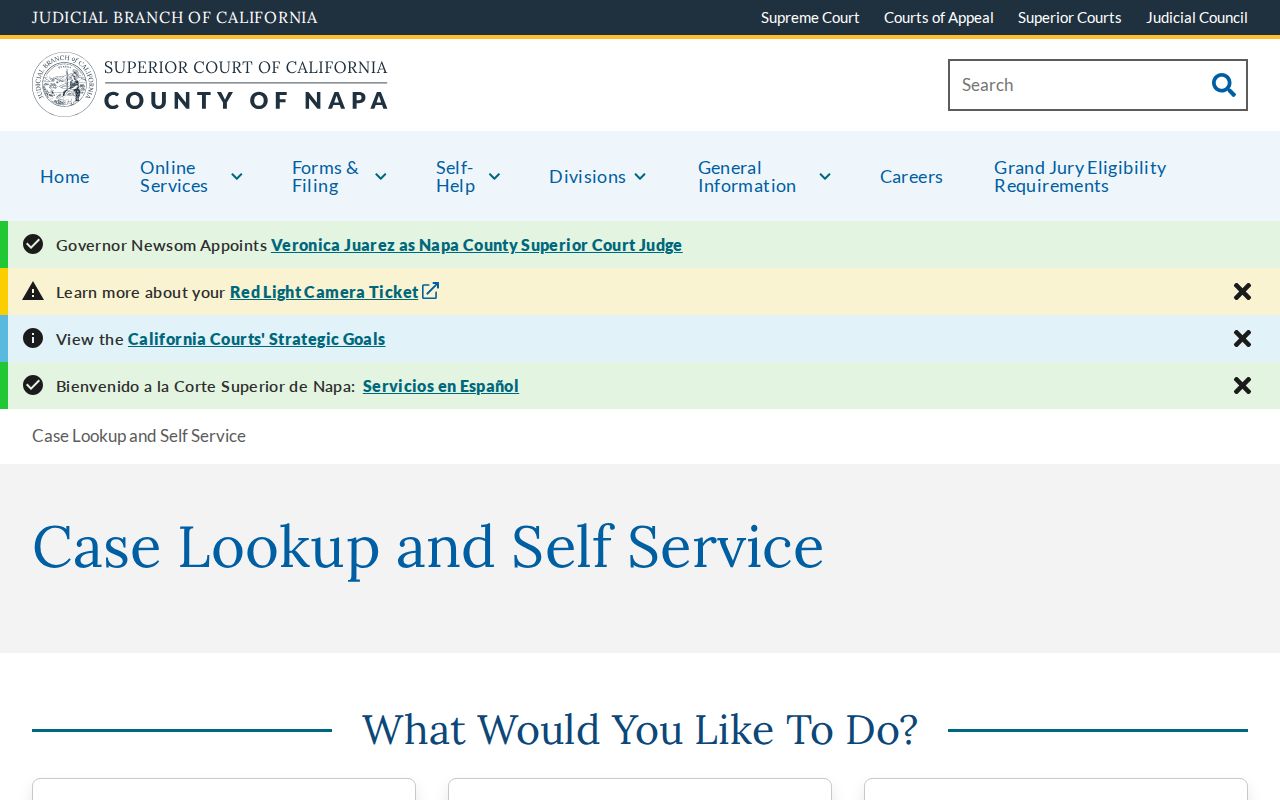
The screen is a route to basic information and calendar tools, not proof that a full file or every name variant is online.
The criminal request form asks for the searched person and any discriminators, then lets the requester identify copies, sentencing information, or another specific need. A pulled criminal file remains at Criminal Division for ten days after notice. After that window, it returns to archive and a new search is required. That short shelf life makes prompt follow-up part of the lookup.
| Field | Type or requirement | Notes or options |
|---|---|---|
| Name | text, essential | Person searched; aliases separate |
| Date of Birth | date, optional discriminator | Helps same-name matching |
| Driver's License Number | text, optional | Sensitive; use only on official form |
| Case Number(s) | text | If known |
| Violation(s); Date(s) | text/date | Optional |
| Copies | checkbox plus lines | Describe documents |
| Certified Copies | checkbox | $40 certification |
| Sentencing Information | checkbox | No option listed |
| Copies for Department of Immigration | checkbox | No option listed |
| Other | checkbox/text | Describe the request |
| Visa/MasterCard; number; expiration; CVV | radio/payment fields | Required for mailed payment route |
| Cardholder and billing/mailing address | text | Payment and delivery record |
| Signature | signature | Authorization |
| Requester name/phone | text | Contact |
| Delivery | checkboxes | Pick up; mail; fax; fax number conditional |
Use the criminal record and files search request for the court's form fields. The form's delivery choices do not change the access rule: the request itself is mailed or delivered in person, and email is not accepted.
Napa Resident Lookup Through Vital Records
Vital records can confirm an event, but looking up a resident must follow the right custodian and eligibility rule. Napa County Vital Statistics registers and issues births and deaths from the last 12 months at 2751 Napa Valley Corporate Drive, Building B, first floor, with appointment service and phone 707-253-4506. Older events go to the Recorder-County Clerk, which handles births and deaths occurring in Napa County and marriages licensed in Napa County. The Recorder counter is open 8-4:30; mail goes to P.O. Box 298, fax to 707-259-8149, and stated processing is two to three business days.
| Record | Custodian | Public index? | Copy or access | 2026 fee |
|---|---|---|---|---|
| Birth ≤12 months | County Vital Statistics | None located | Authorized or informational; sworn statement | $34 local |
| Birth >12 months | Recorder or CDPH | No official Napa web name index | Authorized or informational | $34 Napa; $31 CDPH |
| Death ≤12 months | County Vital Statistics | None located | Authorized or informational | $26 |
| Death >12 months | Recorder or CDPH | No official Napa web name index | Authorized or informational | $26 |
| Public marriage licensed in Napa | Recorder or CDPH | No official Napa web name index | Authorized or informational | $19 |
| Confidential marriage | Recorder | Not public | Parties or court-authorized route | $19 |
| Divorce court file | Napa Superior Court | Basic portal when public | Clerk search and file copies | $0.50/page; $40 certified |
| State dissolution certificate | CDPH | No public name index | VS 113B; not full decree | $18 |
The California Department of Public Health Vital Records fee schedule lists 2026 mail fees of $31 for birth, $26 for death, $19 for marriage, $18 for dissolution, $23 for fetal death, and $28 for stillbirth. A failed search produces a Certificate of No Public Record, and the fee is retained under Health and Safety Code section 103650. Checks and money orders go to CDPH Vital Records; cash is not accepted. Napa's local birth fee is $3 higher than CDPH's mail fee, while the local route may be faster.
Health and Safety Code sections 103525-103526 distinguish authorized from informational copies. Informational birth, death, and public-marriage copies carry the statement, “INFORMATIONAL, NOT A VALID DOCUMENT TO ESTABLISH IDENTITY.” Authorized classes include the registrant or parent or legal guardian; child, grandparent, grandchild, sibling, spouse or domestic partner; a court-order holder; qualifying attorney or adoption agency; an official law-enforcement or government representative; and designated legal or estate representatives. Family Code section 509 limits confidential marriage certificates. Adoption files and original birth records are sealed under Health and Safety Code section 102705, subject to statutory or court procedures. California has no simple 100-year or 50-year opening schedule for ordinary modern birth and death certificates.
The Napa certificate application asks for certificate type, certificate name, second marriage name when relevant, event date, parent name for birth or death, city of event, copy quantity, authorized or informational selection, applicant contact details, relationship or authorized-person category, signature or sworn declaration, and payment method. Mail requests require a notarized sworn statement; counter applicants sign before staff. Napa accepts cash, qualifying checks, cashier's checks, money orders, traveler checks, or card with a $2.50 processing fee, but not out-of-state personal checks. The official extraction did not expose every lower-page checkbox verbatim, so only the verified fields are stated.
Napa Voter Lookup Limits
California My Voter Status authenticates the voter who is checking a record. It is not a stranger-name directory. The form asks for exact identity fields, and the result can show registration status and address, party preference, election-material language, vote-by-mail or provisional status, polling place, upcoming elections, county contact, and guide-delivery preference. Recent online registration may take 24 hours. Napa's election-specific tool begins about 60 days before an election.
The authenticated form uses these fields:
- First Name: text, required.
- Last Name: text, required.
- Date of Birth: month, day, and year controls, required.
- California DL/ID Number: conditional; the record needs this or the last four digits of the SSN.
- I do not have a California DL/ID: conditional checkbox.
- SSN last four: conditional; the portal recommends both identifiers where available.
- I do not have an SSN: conditional checkbox; contact Elections if neither identifier exists.
The California voter file is a separate, restricted route under Elections Code sections 2188, 2194, and 18109 and 2 CCR sections 19001 et seq. Lawful purpose classes are election, scholarly, journalistic, political, or governmental work. The Napa application requires a written application, ID copy, original wet signature, mail or hand delivery, and full payment. Qualification boxes include Political Campaign, Scholarly, Journalistic, Record Review, Private Vendor, Government Agency, Political Party Central Committee, and Other. Purpose boxes include Mailings, Walking Neighborhoods, Data Analysis, Phone Bank, and Other. Possible files include district, party, five-election history, returned or issued vote-by-mail files, precinct and district files, active voters, and paper precinct maps. Driver or state ID numbers, last four SSN, unique identifier, and signature are never released. Confidential voters are excluded.
Electronic output is plain-text tab-delimited secure transfer. The application states two to three business days, and it bars unsecured storage, online publication, unauthorized redistribution, use outside the approved purpose, and transfer outside the United States. There is no casual public by-street voter browse. The voter route is either the person's own authentication or an approved statutory request.
The authenticated My Voter Status screen helps show why a Napa resident lookup cannot treat voter status as an open name search.
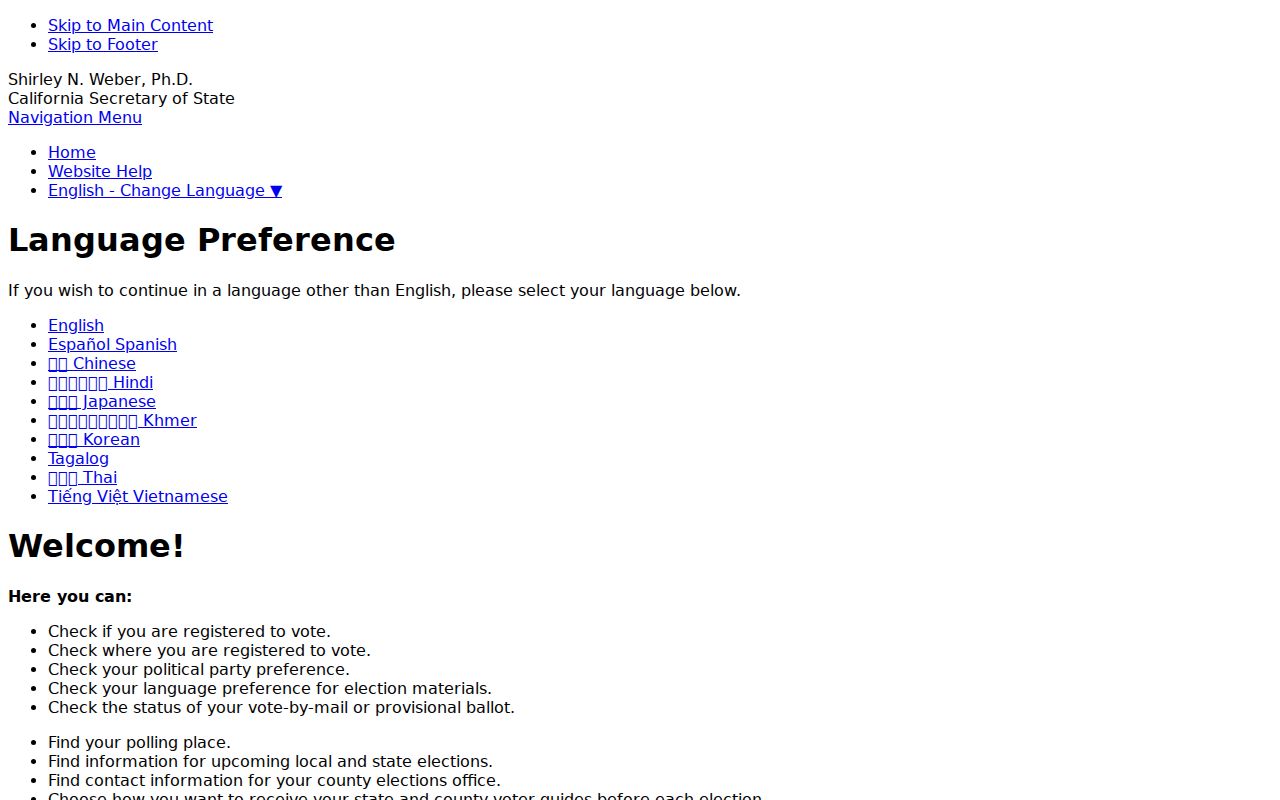
Identity checks protect the voter record and keep the public search question separate from a person's own status check.
Napa Probate Record Routes
An heir or estate search needs the probate file, not a guess based on a mailing address. Search the Napa Superior Court probate index by decedent and likely personal representative, then inspect public petitions, notices, inventories, or decrees as appropriate. A Recorder post-death affidavit or distribution deed can identify a successor to Napa real property. Cross-check the representative's address, but do not assume every named beneficiary still lives there. A court filing shows the relationship or role stated in that filing, not a guarantee about a person's current location.
Adoption is a separate lawful route. Juvenile, adoption, sealed, and confidential family material is not an ordinary public name-search result. Napa Local Form AD-1 asks to inspect adoption records under Family Code section 9200 et seq. and requires exceptional circumstances and necessity. California adoption-information procedures, CDPH forms, agency channels, court orders, and statutory intermediary routes are the proper paths. Original birth records and adoption files remain subject to Health and Safety Code section 102705. A name search should never promise a public birth-parent search.
Napa Inmate Lookup Limits
The California Department of Corrections and Rehabilitation Incarcerated Person Locator is free and can cover current and some former state prisoners. It supports name or CDCR-number searching and age sorting. Results can include name, age, CDCR number, location, admission, commitment county, and parole-eligible month or year. It is a state-custody tool, not a complete criminal history and not proof of a Napa residence.
The official California Megan's Law search offers name and map or address-vicinity modes after its disclaimer.
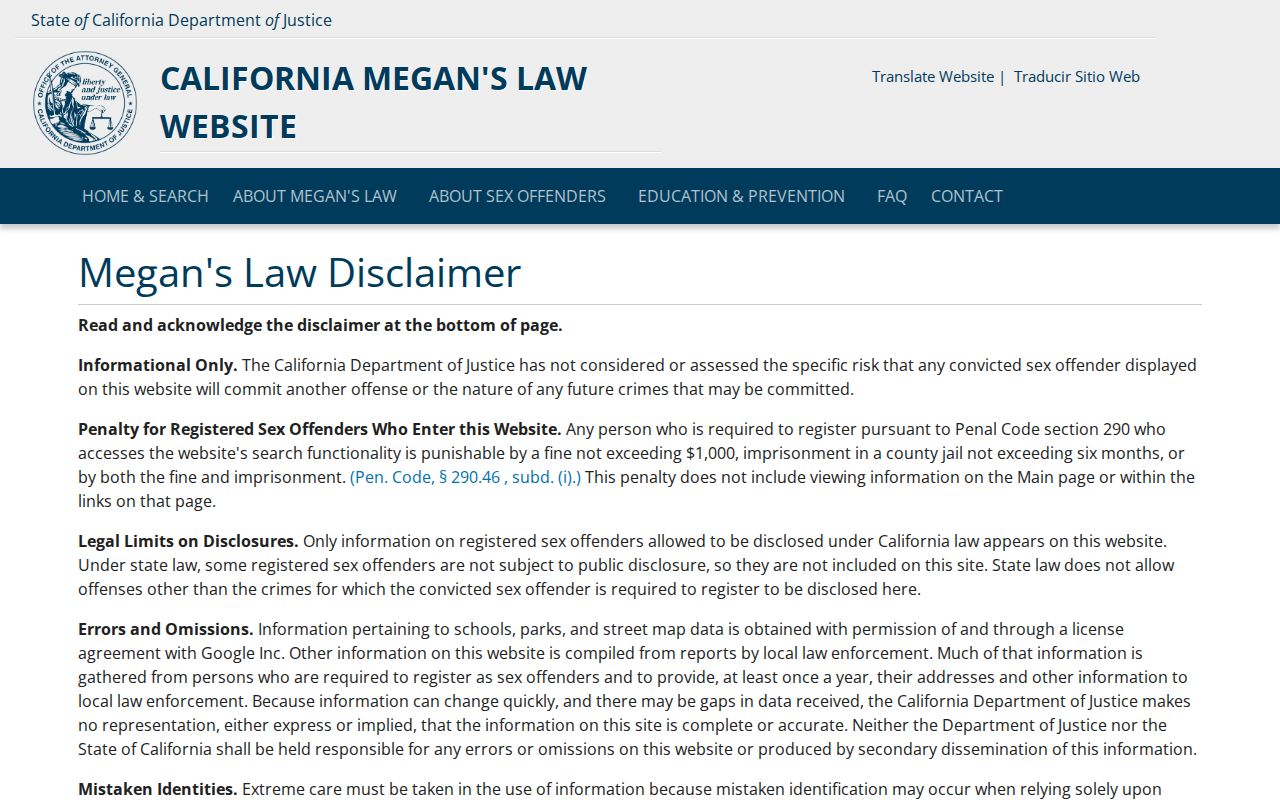
A registry result may show a photo, description, offense information, and mapped information as the law allows, with statutory exclusions and a misuse warning. A custody or registry hit is not residence evidence. Match the name with a birth date, number, record date, and an independent Napa source before drawing a conclusion.
For a local report, booking, warrant, or Sheriff record, the Napa County Sheriff Records Bureau is the counter and records fallback. It is at 1535 Airport Boulevard, second floor, with 707-253-4440, counter hours on weekdays 8-5, and a bureau staffed 24 hours. A focused records request should name the report or case and use the official office channel.
Napa Business Record Checks
Business records can corroborate a person's role without turning a business address into a home address. The Napa FBN search accepts Filing Number, Business Name, Registrant Name, Active Filings Only, and Include Abandoned Filings. An FBN links a registrant to a business and declared address. It does not establish that the address is a personal residence. Ordinary FBN copies cost $2, a certified FBN copy costs $5, and a copy or certificate of no record costs $9 under the cited schedule.
The California Department of Consumer Affairs license search has fields for Boards or Bureaus, License Type, License Number, Business Name, First, Last, and Registry Number.
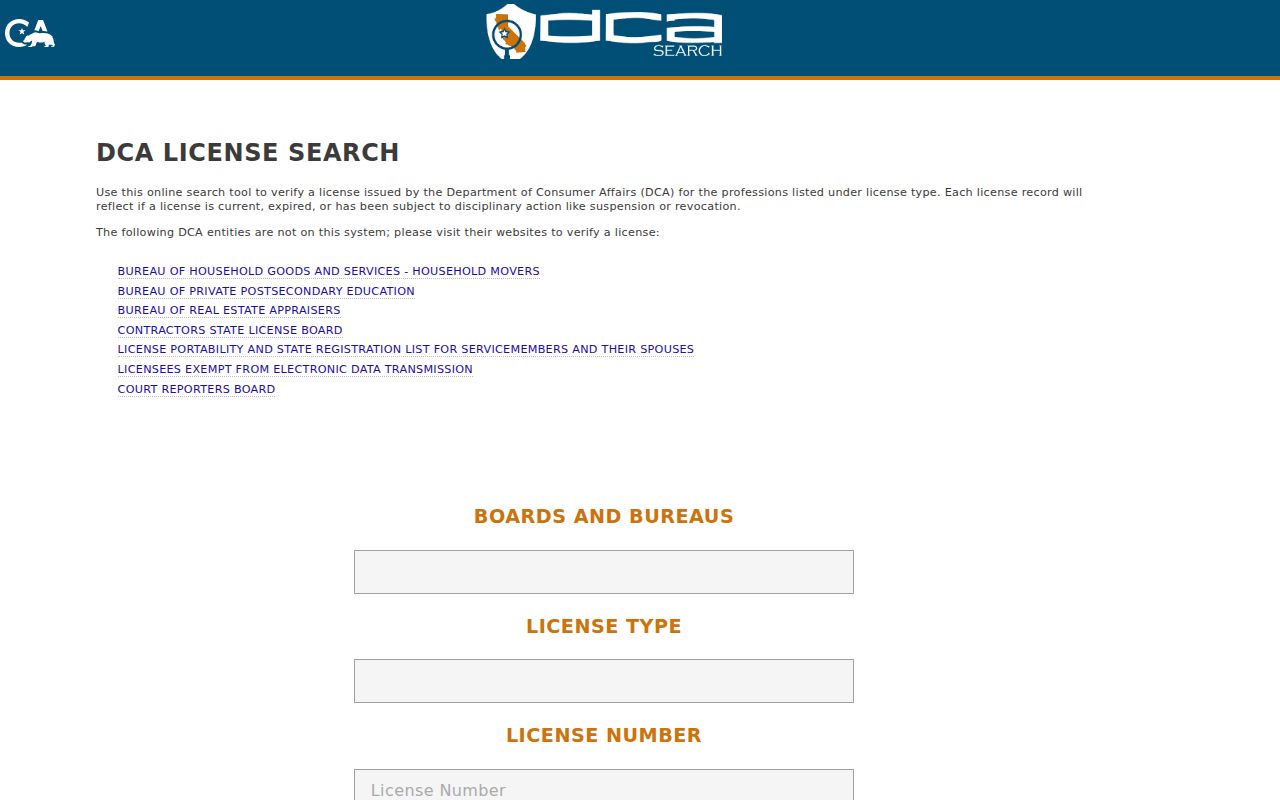
Advanced DCA filters add up to ten license types, cities, or counties, plus primary or secondary status, disciplinary actions, and public documents. Results can identify current, expired, suspended, or revoked status and discipline. Some regulators keep separate tools. A license address may be a business or mailing address.
The California Secretary of State bizfile search supports a name or file-number search, keyword names, and a corporation number without the “C.” It caps the closest results at 500. Advanced filters cover entity grouping or type, status, initial filing-date range, and publicly traded disclosure. Corporations, LLCs, LPs, and nonprofits are included; LLPs and general partnerships are excluded. Basic search is free, while filings and certificates can cost.
The image capture below represents the SOS business search route used to check a Napa affiliation.
Entity details can show entity number, type, status, jurisdiction, initial date, principal and mailing addresses, agent, officers, directors, managers, and filing history. Separate a registered agent, manager, officer, and FBN registrant. They are distinct roles and none alone proves residence.
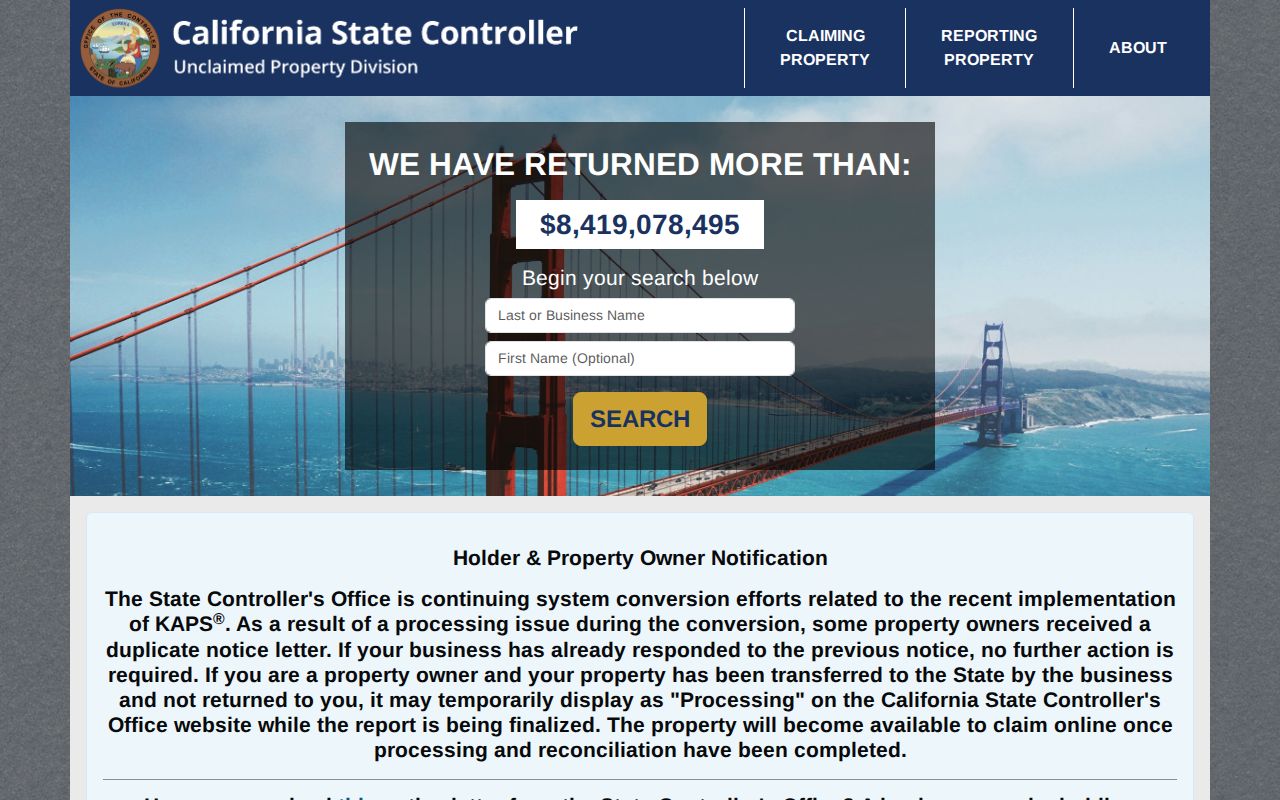
The California State Controller's unclaimed-property search is a useful category check when a person may have a stale financial lead. A name search is free and can return a reported former city or address fragment, followed by a claim workflow. The data is stale by design. It may help connect a former Napa tie, but it cannot prove a current residence, an active address, or identity without the Controller's claim process and other records.
The official Controller search is the proper place to test a name before paying anyone for a lead.
Use an unclaimed-property result as one small corroborating point, then return to the source offices that hold current or historical records.
Napa Privacy And DROP
California's CCPA and CPRA, Civil Code sections 1798.100 et seq., provide access or knowledge, deletion, correction, opt-out of sale or sharing, sensitive-data limits, and nondiscrimination rights. The DELETE Act created DROP. Starting in January 2026, a California resident can send one deletion or no-sale request to more than 500 registered brokers, with broker processing beginning August 1, 2026. DROP affects commercial copies and broker records, not the source records held by a Napa County office, court, or state custodian.
Safe at Home gives qualifying survivors and other protected participants a substitute mailing address and mail forwarding. Qualifying groups include survivors of domestic violence, stalking, sexual assault, child abduction, elder or dependent-adult abuse, and trafficking, along with certain threatened reproductive or gender-affirming personnel and public workers. The program can support confidential voting. Government Code section 6208.1 restricts public display after written demand and threatening display, but it does not erase every historic record.
Other boundaries matter when you look up a resident in Napa. Voter ID numbers, SSNs, signatures, sealed matters, juvenile and adoption files, confidential family material, and protected DMV information are not open fields. Recorded documents can receive statutory redaction or protected-address treatment. A missing address may reflect a safety program or a lawful redaction rather than a bad match.
Correct Napa Source Records
When a result is wrong, correct the source record rather than a downstream copy. Send an assessment ownership question to the Assessor or Recorder. Send a registration change to Napa Elections. Send a docket concern to the court clerk or the procedure for that case. Vital amendments use CDPH or the local registrar's statutory forms. A license or business error belongs with the board or Secretary of State custodian. Keep the disputed output, the source URL or form, and its retrieval date while the correction is pending.
If an online source stops short, call the desk with a document, APN, case, or license number; visit the Recorder or court public terminal; use the prescribed mail or counter form; or make a focused request under the California Public Records Act, Government Code sections 7920.000 et seq. The agency's determination is generally due within 10 calendar days and may be extended by 14 days for unusual circumstances. A focused request should identify an existing record, date range, name variants, and desired format. An agency need not create a new list or answer an open-ended research question.
Lawful personal use. Napa records support genealogy, reconnecting, estate research, civic review, and personal verification. Do not use a name, address, court result, voter record, or registry entry to stalk, harass, threaten, or intimidate anyone.
A careful one-person search ends with the custodian's record, its access rule, and a clear reason for treating two records as the same person. That is the difference between a useful Napa lead and an unsupported conclusion.